Updated: November 12, 2026
Is Rereading a Good Way to Study? Why a Familiar Page Fools You, and Four Habits That Work Better
Short answer
Not on its own. Rereading and highlighting feel productive because the page gets familiar, but familiar is not the same as remembered. A large 2013 review rated both low and gave its only high ratings to self-testing and spaced study. So read once, close the book, write what you recall, check it, and come back after a gap. Save rereading for the parts you missed.
Why does rereading feel like it works?
Because the second pass is easier than the first, and ease passes for learning. You know the layout and can almost guess the next line. That comfort is genuine, but it tracks recognition, not recall.
The book opens on Lena, 46, a bookkeeper preparing for part of the CPA exam. She is on her fourth pass through her notes this week. Twenty minutes after rereading a topic, she attempts a practice question on it and comes up empty.
Her memory is fine. In a 2011 book chapter, Bjork and Bjork warn that repeated exposure breeds a familiarity people easily mistake for understanding. Spotting a page and producing its content are separate skills, and exams test the second one.
What does the research say about rereading?
Rereading is weak, not harmful. In four experiments a second read rarely moved test scores, and a major review placed it in its lowest group alongside highlighting.
Reading a textbook chapter twice instead of once seldom produced a reliable gain on later tests, and stronger readers fared no differently (Callender and McDaniel, Contemporary Educational Psychology, 2009).
In 2013, a team led by Dunlosky graded ten popular techniques in Psychological Science in the Public Interest. Here are the four habits most adults use, with what other studies add.
| Study habit | Usefulness rating (Dunlosky and colleagues, 2013) | How it feels while you do it | What other studies add |
|---|---|---|---|
| Rereading | Low | Smooth and fast. Every page looks friendly. | Did not reliably raise test scores in four experiments (Callender and McDaniel, 2009). A reread after a gap can help a little. |
| Highlighting | Low | Busy and productive. The page fills with color. | Small boost to memory but not to comprehension; it helped college students but not school students (Ponce, Mayer and Méndez, 2022). |
| Practice testing | High | Slow and a bit embarrassing. You find gaps. | Medium gains across 222 classroom studies (Yang and colleagues, 2021). Not yet proven for math. |
| Spacing your study out | High | Like you forgot too much between sessions. | In a 2006 synthesis, just 12 of 271 head-to-head tests showed no gain or a loss (Cepeda and colleagues). |
One caveat: in a 2012 survey of 324 undergraduates, Hartwig and Dunlosky found both rereading and self-testing linked to higher GPA. It is only a correlation, but it argues against calling rereading useless.
Why does the better method feel worse?
Because effort feels like failing. People judge the harder method as less effective and drop it, even when it is the one that lasts.
In a randomized 2019 study of college physics classes (Deslauriers and colleagues, PNAS), students in active classes learned more than lecture students yet felt they had learned less. Kirk-Johnson, Galla and Fraundorf (Cognitive Psychology, 2019) saw the same split: effortful strategies got lower ratings but went with better long-term memory.
Judging your learning after a delay is far more accurate than judging it right away, g = 0.93 across 112 effect sizes from 4,554 people (Rhodes and Tauber, Psychological Bulletin, 2011).
The book’s refrain sums it up: if it feels easy, it probably isn’t sticking.
Step 1: What should you do instead of rereading a section?
Shut the book and test yourself. The book calls this the Closed-Book Check: five minutes that replace the sense of knowing with proof, and aim your next minutes at the holes.
- Study one short chunk, no more than a page or two, then pause.
- Shut the book or flip your notes over.
- Jot the key points from memory in brief phrases. Define any term in your own words.
- Open the source, compare, and mark every miss or error.
- Reread just the marked parts, close the book again, and retry them.
- Retest the same chunk a day or a few days later. It counts as learned only if it survives the wait.
Rereading survives in step 5, aimed only at the marked lines. Dunlosky’s 2013 teacher article makes the point that a failed recall shows you what to restudy, while a reread makes every page feel equally fine.
The anchor study is Roediger and Karpicke (Psychological Science, 2006). One group recalled prose passages on paper; the other restudied them as often. Restudy won a test five minutes later. Recall won clearly after two days and after a week, even though the restudy group felt more confident.
Across 222 classroom studies with 48,478 students, quizzing raised achievement by a medium amount, g = 0.499 (Yang and colleagues, Psychological Bulletin, 2021).
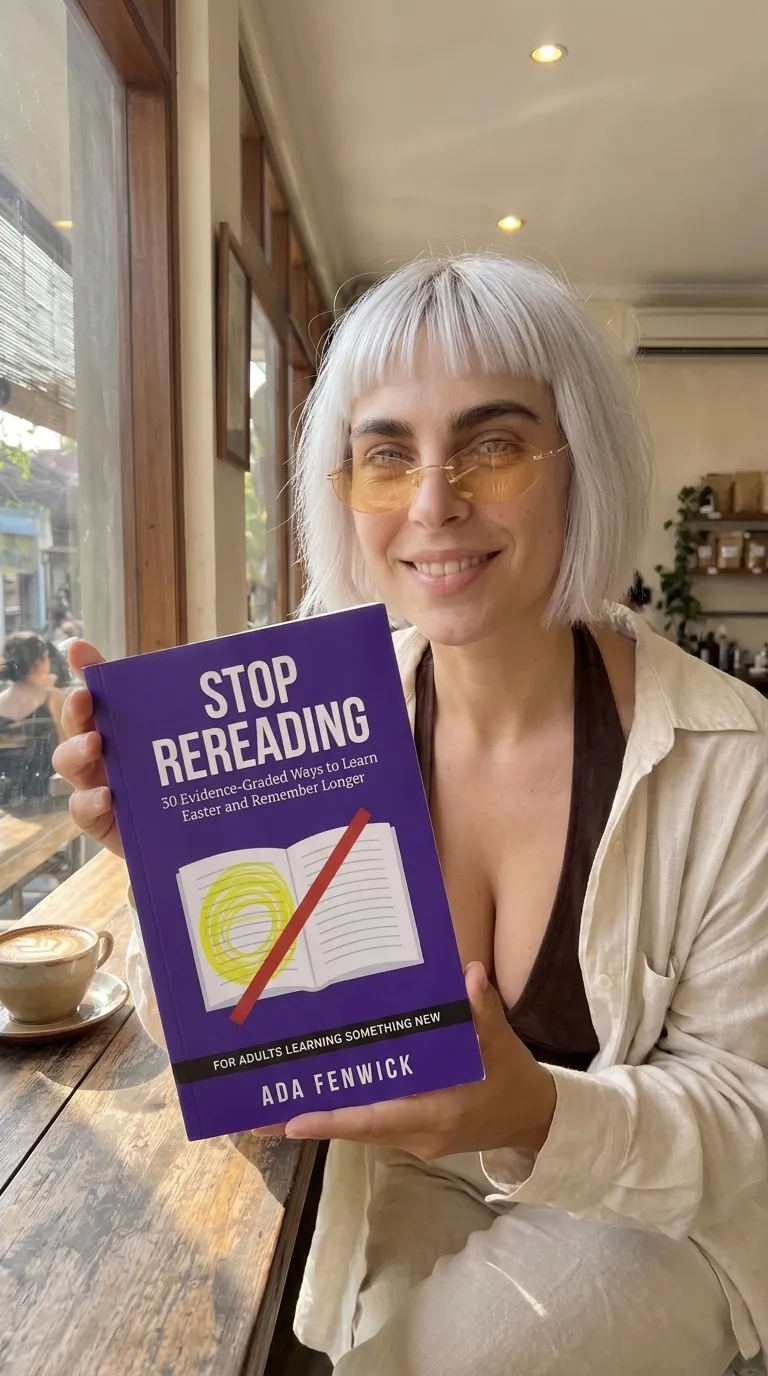
Step 2: How do you practice recall on a whole topic?
Use a blank page and two pens. Write everything you remember for ten minutes, then fill the gaps in a second color. That second color is your study list.
- Close every book, tab and note. Write the topic at the top of a blank page.
- If the topic is big, write 3 to 5 headings as cues. Leave space under each.
- For 10 minutes, write everything you remember. Lists, arrows and rough sketches all count. No peeking.
- Open your source. Use the second pen to add what you missed and fix what you got wrong.
- Restudy only what the second pen wrote.
- On a later day, do it again on a fresh page and compare the two.
The book calls this the Blank Page. Headings help because cued recall beat recall from nothing. Writing beats picking: in a real college course, short-answer quizzes helped more than multiple choice (McDaniel and colleagues, European Journal of Cognitive Psychology, 2007).
Testing beat restudying by g = 0.50 on average across 159 results from 61 studies; with feedback the benefit rose to 0.73, without it 0.39 (Rowland, Psychological Bulletin, 2014).
Checking is not optional. In the same data, people who recalled half or less and got no feedback gained almost nothing (g = 0.03). And recall is not only for facts: it beat concept mapping on inference questions in a 2011 Science study by Karpicke and Blunt.

Step 3: How do you use flashcards without fooling yourself?
Keep one big shuffled stack, answer before you flip, and never retire a card you got right. Flashcards are recall practice in a box, but three habits waste most of the effort.
- Write one idea per card: a question or cue on the front, the answer on the back.
- Keep all the cards for a topic in one stack. Shuffle it.
- Before you flip, say or write your answer. A silent “yeah, I know that” doesn’t count.
- If you were wrong, read the answer slowly and put the card back a few cards down.
- If you were right, the card still stays in the deck.
- Stop when every card has come up right at least once. Run the same deck again on another day.
One large stack beat four small ones for 90 percent of learners, yet after the first session 72 percent believed the small stacks had worked better (Kornell, Applied Cognitive Psychology, 2009).
Small piles feel smooth because each card returns quickly, which is exactly the problem. Dropping known cards also hurt learning slightly but steadily (Kornell and Bjork, Memory, 2008). And the answer side matters most after a miss: in a study of 258 people learning Luganda-English pairs, seeing the answer after an error made a large difference a week later (Pashler and colleagues, Journal of Experimental Psychology: Learning, Memory, and Cognition, 2005).
Step 4: How far apart should study sessions be?
Far enough that some forgetting sets in, and the right gap grows with the time until your test. Pick a gap from the table, put review days on a calendar, and make each review a recall session.
Few ideas in learning science have been checked as often. A 2006 synthesis by Cepeda and colleagues in Psychological Bulletin drew on 839 assessments from 317 experiments, and spacing helped at every retention interval. Their 2008 follow-up in Psychological Science tested over 1,350 people with review gaps as long as 3.5 months and final tests as late as a year out.
| Time until the test | Gap between reviews | Where the number comes from |
|---|---|---|
| About 1 week | 1 to 3 days | Reported: 20 to 40 percent of the wait (Cepeda and colleagues, 2008) |
| 2 to 3 months | About 1 to 2 weeks | The book’s own estimate, read between the two reported results |
| About 1 year | 3 to 5 weeks | Reported: 5 to 10 percent of the wait (Cepeda and colleagues, 2008) |
The book’s Spacing Calendar is a SOLID tool that takes about 10 minutes to plan with a calendar and your exam date.
- Count the days from today to the exam.
- Choose your gap from the table.
- Note when you first study each topic, then add reviews spaced one gap apart until exam day.
- Run every review as a Blank Page or a pass through your cards, never a reread.
- Missed one? Do it at the first chance and count the next gap from there.
- In the final week, fit in one or two quick sweeps of everything, a day or two between them.
Don’t chase the perfect number. Any gap beats none, and in the 2008 data results only declined slowly past the best point.
Does testing yourself work for every subject?
Not proven for math yet. Retrieval practice is the book’s best-supported method, but the math evidence is thin. Spacing did hold up in math, so lean on spaced practice of earlier problems.
Only seven math studies compared testing with restudying; the average was g = 0.18, and the authors called the effect “not robust” (Murray, Horner and Göbel, Educational Psychology Review, 2025).
That may just reflect how few studies exist, so it is not disproven. The same review found a small to medium benefit for spacing in math, g = 0.28 from 27 studies. For math, the book swaps the blank page for a few earlier problems worked without notes.
When is rereading still worth doing?
After a gap, and after a recall attempt. A reread that follows a closed-book check goes straight to what you missed. A reread that replaces the check only polishes what already feels familiar.
Dunlosky’s 2013 American Educator article grants that spaced rereading can help, then adds that the same minutes would do more with another strategy. A delayed reread earns its place. A self-test earns more.
Which study myths can you stop worrying about?
Several famous claims about studying failed when researchers checked. Dropping them frees time for recall and spacing.
- Learning styles. A major review found no solid evidence for testing people’s styles and teaching to them (Pashler and colleagues, Psychological Science in the Public Interest, 2008). Match the method to the material instead.
- The “10% of what we read” pyramid. Letrud and Hernes traced versions back more than 160 years and found none of them came from actual research (Cogent Education, 2018).
- Laptops ruin note-taking. That idea rests mostly on one 2014 study. A direct replication with 74 laptop users and 68 longhand note-takers found laptop users did no worse on the quiz (Urry and colleagues, Psychological Science, 2021).
The book these four tools come from
 Stop Rereading on Amazon (opens in a new tab)
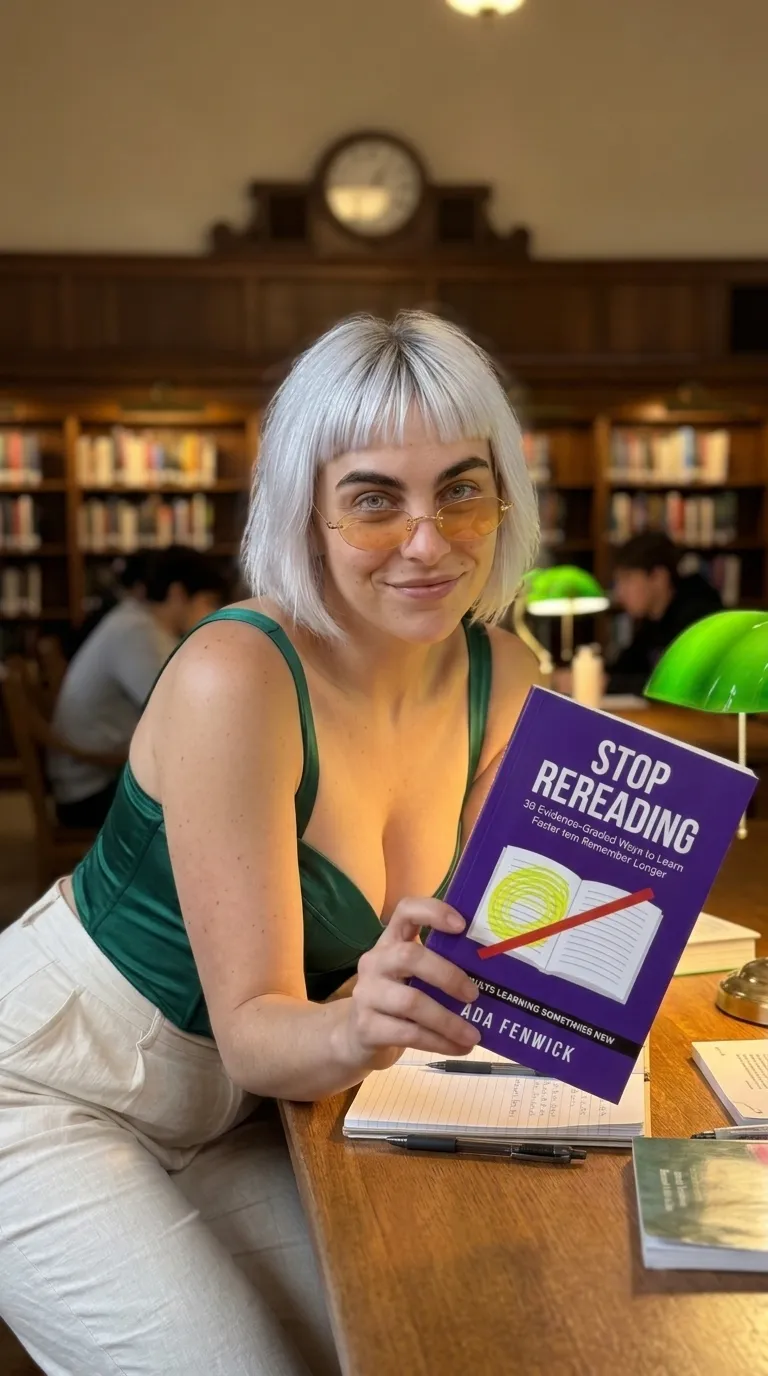
by Ada Fenwick
Stop Rereading by Ada Fenwick is written for adults studying alongside work and family, whether that means a certification, a class, a new language or a new field at work. Its 30 tools each carry an evidence badge: SOLID for 17, PROMISING for 11 and STORY ONLY for 2.
This guide gives away four tools from the book’s fast path. The rest covers mixing problem types, explaining ideas aloud, notes, reading, sleep, phones and using AI as a coach.
- 1. The Rereading Trap: why a familiar page fools you, the Closed-Book Check and the Confidence Bet
- 3. Retrieval Practice: the Blank Page, Flashcards Done Right and a worked week for a language learner
- 4. Spacing: the Spacing Calendar, a three-box card system and a worked plan for a cumulative final
- The 30-Day Plan: the tools in order, day by day, with study log pages and a blank Spacing Calendar
It fits if
- You are studying for a certification, a course or a new role and your time is short
- You reread and highlight, and still blank on practice questions
- You want to know which study tips have evidence and where that evidence stops
Skip it if
- You want to improve a physical skill like an instrument or a golf swing; see how to get past a learning plateau, built on the companion book The Practice Lab
- You want a memory trick that promises instant results
- You need help with an ongoing sleep or attention problem; talk to a health professional
Questions people ask about rereading and studying
Is rereading notes a waste of time?
Not a waste, but a weak use of time. A 2013 review rated rereading low, and four experiments found it rarely raised scores. A reread after a gap helps a little; writing what you recall with the book closed helps more.
Is highlighting a good way to study?
Only a little. A 2022 meta-analysis found a small boost to memory but not to comprehension, for college students but not school students. Turn each highlight into a question and test yourself on it.
How many days apart should I space study sessions?
It depends on the test date. In a study of more than 1,350 people, the best gap was about 1 to 3 days for a test a week away and 3 to 5 weeks for a test a year away. For two or three months out, the book estimates 1 to 2 weeks.
Does testing yourself work for math?
Not proven yet. A 2025 review found only seven math studies comparing testing with restudying and called the effect not robust, though not disproven. Spacing did help in math, so spaced practice on earlier problems is the safer bet.
Sources
- Bjork and Bjork, Making things hard on yourself, but in a good way, in Psychology and the Real World (2011)
- Callender and McDaniel, The limited benefits of rereading educational texts, Contemporary Educational Psychology (2009)
- Dunlosky et al., Improving students’ learning with effective learning techniques, Psychological Science in the Public Interest (2013)
- Dunlosky, Strengthening the student toolbox, American Educator (2013)
- Deslauriers et al., Measuring actual learning versus feeling of learning, PNAS (2019)
- Rhodes and Tauber, delayed judgments of learning: a meta-analytic review, Psychological Bulletin (2011)
- Roediger and Karpicke, Test-enhanced learning, Psychological Science (2006)
- Rowland, The effect of testing versus restudy on retention, Psychological Bulletin (2014)
- Yang et al., Testing (quizzing) boosts classroom learning, Psychological Bulletin (2021)
- Kornell, Optimising learning using flashcards, Applied Cognitive Psychology (2009)
- Cepeda et al., Distributed practice in verbal recall tasks, Psychological Bulletin (2006)
- Cepeda et al., Spacing effects in learning: a temporal ridgeline of optimal retention, Psychological Science (2008)
- Murray, Horner and Göbel, spacing and retrieval practice for mathematics learning, Educational Psychology Review (2025)
- Pashler et al., Learning styles: concepts and evidence, Psychological Science in the Public Interest (2008)
- Letrud and Hernes, Excavating the origins of the learning pyramid myths, Cogent Education (2018)
- Urry et al., Don’t ditch the laptop just yet, Psychological Science (2021)
- Stop Rereading by Ada Fenwick, How to Use This Book and chapters 1, 3, 4, 7, 9 and 10
