Updated: November 4, 2026
Old Canning Methods That Are No Longer Safe, and What Replaced Each One

Short answer
The old canning methods now advised against are open-kettle canning, oven canning, paraffin wax on jam and jelly, and canning low-acid food like green beans in a boiling-water bath. Tomatoes now get added acid in every jar. Inverting jars and adding aspirin don’t work either. Pressure canners vent for 10 minutes, and each recipe has its own altitude table. The replacement is the same everywhere: a tested recipe from the USDA, the National Center for Home Food Preservation or your extension office.
Which old canning methods are no longer recommended?
Ten old practices show up most often on family recipe cards. Here each one sits beside current guidance and the safer swap. Badges come from the book this guide draws on, which rates each skill SAFE TODAY, UPDATE IT or RETIRED.
| The old way | Current guidance | Do this instead | Source |
|---|---|---|---|
| Open-kettle canning: cook the food, pour it into sterilized jars, seal, no more heat | Not recommended. It does not prevent all risks of spoilage (NCHFP). Badge: RETIRED | A tested recipe in a boiling-water canner for acid food, a pressure canner for low-acid food | NCHFP, Equipment and methods not recommended |
| Oven canning at 250 to 275°F | Not recommended, along with microwaves and dishwashers. Badge: RETIRED | Same as above. Never “process” jars in an oven | NCHFP; WVU Extension |
| Hot paraffin poured over jelly and jam | “No longer recommended for any sweet spread” (USDA Guide). Badge: RETIRED | Two-piece lid and a short boiling-water process | USDA Complete Guide; NCHFP |
| Tomatoes packed with salt and juice, no acid step | Every jar gets added acid, even in a pressure canner. Badge: UPDATE IT | Per quart: 2 tablespoons bottled lemon juice or 1/2 teaspoon citric acid | USDA Guide 3; NCHFP |
| Green beans or other low-acid food in a boiling-water bath | Never advised, even in 1942. No safe water-bath option for green beans | Stovetop pressure canner and a tested recipe | USDA 1942 bulletin; NCHFP; CDC |
| Venting the pressure canner 4 to 7 minutes | Vent every pressure canner 10 minutes before pressurizing. Badge: UPDATE IT | Let steam flow freely for a full 10 minutes, then add the weight | NCHFP |
| One altitude rule: add 20 percent per extra 1,000 feet | Each tested recipe has its own altitude table. Badge: UPDATE IT | Read the column for your elevation in the recipe | USDA Guide; NCHFP |
| Glass caps with wire bails, zinc caps with rubber rings, reused flat lids | Old caps not recommended; metal flat lids are made for one use. Badge: UPDATE IT | Mason jars with new two-piece self-sealing lids; reuse jars and bands | NCHFP; NDSU Extension |
| Turning hot jars upside down so they seal | Listed as a cause of seal failure | Process the jars, then cool them upright | NCHFP |
| An aspirin in the jar to keep the food | “Aspirin should not be used in canning” | Adequate heat from a tested process | NCHFP |
The table gives the rule, not a recipe. Processing times depend on the food, jar size, pack style and altitude, so copy them from a tested recipe every time.
Why did the advice change if Grandma’s jars turned out fine?
Because the research behind the old advice was thin. Our grandparents were not careless. They followed the best bulletins they had. In the 1980s, an extension center at Penn State made it possible to retest those bulletins, and the USDA Complete Guide to Home Canning came out in 1989.
Some older directions were withdrawn after expert review. As of 2026, the current Guide is the 2015 revision, and the National Center for Home Food Preservation (NCHFP) hosts it for free.
The worry is botulism. The CDC says you cannot see, smell or taste the toxin that causes it. It names home-canned vegetables as the most common cause of botulism outbreaks in the United States. A jar that looked fine for forty years tells you about luck, not about the method.
What was wrong with open-kettle and oven canning?
Neither one heats the sealed jar enough. In open-kettle canning, hot food goes into sterilized jars and gets sealed with no more heat. NCHFP rules it out, along with oven, microwave and dishwasher “processing,” because these practices do not prevent all risks of spoilage.
West Virginia University Extension explains the open-kettle gap: germs can get into the food on the way from the kettle to the jar. Oven canning has its own flaw, and the 1942 USDA bulletin admitted it. The oven ran at 250 to 275°F, but the food inside reached only about 212°F. WVU adds that jars explode easily in the oven.
“Dry canning,” heating dry goods in jars, is also not a recommended science-based method. If a card says “pack hot and seal” with nothing after it, match it to the closest tested recipe, or freeze the food instead.

Why is a paraffin seal on jam retired?
Wax lets mold in, and mold on jelly is not as harmless as it looks. Even the USDA’s 1938 jelly bulletin warned that moisture under the wax could break the seal and let molds in. The current Guide says mycotoxins have been found in moldy jelly, so paraffin is no longer recommended for any sweet spread.
The swap is short. Fill hot jam into hot jars with 1/4-inch headspace and put on two-piece lids. Then process in a boiling-water canner. NCHFP’s general rule is 5 minutes for sterile jars or 10 minutes for unsterile ones, plus 1 minute per 1,000 feet above sea level. A recipe with its own table wins.
Don’t cut the sugar in a traditional recipe, NCHFP says, since too little can let yeasts and molds grow. Want less sugar? Use a tested reduced-sugar pectin recipe. If mold shows up, discard the whole jar, not just the top.

Do tomatoes really need lemon juice now?
Yes, every jar. The 1942 bulletin packed tomatoes with juice and a teaspoon of salt per quart, with no acid step. The USDA Guide now says some tomatoes have pH values slightly above 4.6, the line between acid and low-acid food. Added acid brings them back under it.
- Quarts: 2 tablespoons bottled lemon juice or 1/2 teaspoon citric acid.
- Pints: 1 tablespoon bottled lemon juice or 1/4 teaspoon citric acid.
- Vinegar option: 4 tablespoons of 5 percent vinegar per quart, which can change the flavor.
Put the acid in the empty jar before filling. A little sugar can offset the sharp taste. The acid stays even in a pressure canner, since NCHFP’s pressure options were not developed for tomatoes without it. Skip tomatoes from dead or frost-killed vines.

Can green beans go in a water bath if Grandma did it that way?
No. Green beans, meat, soup and plain vegetables are low-acid food and need a pressure canner. This is the oldest rule on the page. The 1942 USDA bulletin already said nonacid foods must be processed in a steam pressure canner. Water-bathed beans never had the USDA’s approval, even then.
The reason is temperature, not pressure itself. NCHFP says a canner at 10.5 pounds of gauge pressure reaches 240°F inside at sea level. Getting the same safety from boiling water would take 7 to 11 hours, the USDA Guide says.
NCHFP: “There is no safe option for processing green beans in a boiling water canner.”
Vinegar doesn’t change this for plain vegetables. Even in 1942, a little vinegar or lemon juice was not enough acid for the water bath. Tested pickle recipes are a separate case.
Two smaller updates apply to pressure canning. Venting went from 4 to 7 minutes in 1942 to a full 10 minutes today. Don’t force-cool the canner, either; let it drop to zero on its own. Summer squash and zucchini directions have been withdrawn. Home canning is not recommended for mashed or pureed pumpkin or winter squash.
What changed for altitude and the dial gauge?
Altitude rules got more exact, and the gauge rule stayed the same. In 1942, one rule covered the water bath: add 20 percent to the time for each extra 1,000 feet. Today each tested recipe has its own altitude column, because water boils cooler as you climb.
Take hot-packed crushed tomatoes in quarts. NCHFP gives 45 minutes at 0 to 1,000 feet, 50 at 1,001 to 3,000, 55 at 3,001 to 6,000 and 60 above 6,000. For most low-acid food in a weighted-gauge canner, use 10 pounds up to 1,000 feet and 15 above.
Dial gauges step up by 2,000 feet: 11 pounds to 2,000, then 12, 13 and 14 up to 8,000 feet. Above 8,000 feet the USDA pressure tables stop, so call your county extension office first.
The dial-gauge check is one old habit that earns SAFE TODAY. The 1942 bulletin warned that gauges drift, and NCHFP still says to check them before use each year. A gauge that reads high leads to under-processing. Off by more than 2 pounds? Replace it. Many county extension offices test gauges.

Does a sealed lid mean the food is safe?
Not by itself. Penn State Extension calls that a common misconception. The seal matters, but safety comes from what happened before it: a tested recipe, the right method and the full time. A jar sealed by the open-kettle method can still be unsafe.
Two kitchen tricks fail the same test. NCHFP lists inverting jars after processing as a cause of seal failure, so cool them upright. And aspirin should not be used in canning at all. Adequate heat treatment is the only safe procedure, NCHFP says.
Lids changed too. Mason jars can be reused many times, but the flat metal lid is made for one use. Screw bands can go back into service once washed and dried. Unused lids work well for at least 5 years from the date they were made, so buy only a year’s worth.

Where do you find tested canning recipes and times?
Three free sources hold the tested recipes. They are the USDA Complete Guide to Home Canning, the National Center for Home Food Preservation at nchfp.uga.edu, and your state’s Cooperative Extension service. Your county office can also tell you your elevation and test a dial gauge.
To update a family card, keep the card and check its method in four steps:
- Name the food type. Fruit, jam and acidified tomatoes go in a water bath. Beans, meat, soup and plain vegetables go in a pressure canner.
- Look for the retired steps. “Pour into hot jars and seal,” “bake the jars” or “pour melted paraffin on top” all need replacing.
- Find the closest tested recipe. Copy its headspace, time and pressure for your jar size and altitude.
- Write it on the back of the card. The family flavor stays in Grandma’s handwriting; the method stays current.
And the jars of unknown age already on a parent’s shelf? The CDC says not to eat food if you don’t know whether safe canning guidelines were followed. Never taste a doubtful jar. Keep the sound jars, buy new lids, and let the contents go.
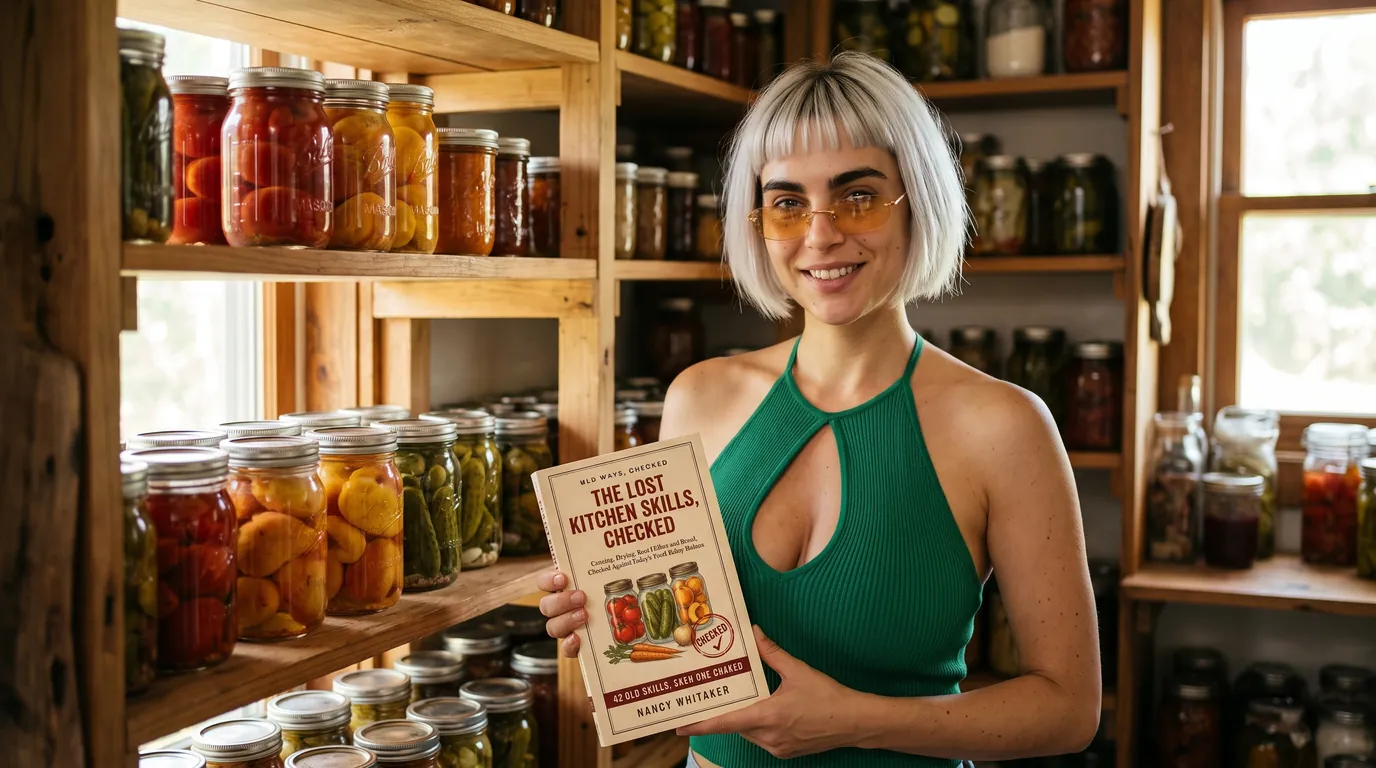
The book that checks every one of these, skill by skill
 The Lost Kitchen Skills, Checked on Amazon (opens in a new tab)
by Nancy Whitaker
The Lost Kitchen Skills, Checked by Nancy Whitaker takes 42 kitchen and pantry skills from our grandparents’ kitchens. Each one shows how it was done, what the USDA, FDA, CDC, NCHFP and extension services say now, and an honest badge. The count: 17 SAFE TODAY, 21 UPDATE IT, 4 RETIRED.
Canning is two chapters of fifteen; the rest covers root cellars, drying, fermenting, bread, stock, dairy, eggs and leftovers. The book prints canning times only from the USDA Guide or NCHFP, lists its sources chapter by chapter, and sends you to the tested recipe for everything else.
- Water-Bath Canning for High-Acid Food: the full water-bath method, acid for tomatoes, lids instead of wax, and why open-kettle and oven canning are retired
- Pressure Canning for Beans, Meat and Soup: 10-minute venting, altitude tables for weighted and dial gauges, and the yearly gauge test
- Kitchen Tools That Last: which old jars, bands and lids can go back into the canner
- The Pantry Workbook: canning record pages and a “Grandma's Recipe Card, Checked” worksheet

It fits if
- You inherited a recipe box or a canner and want to use both safely
- You are starting to can and want the reasons, not just the rules
- You like the old ways and want to know which ones still hold up
Skip it if
- You want a big book of canning recipes; this one points you to the tested ones
- You already can from the USDA Guide and know why each step is there
- You are looking for commercial or market canning rules
Fair doubts
“Nobody in our family ever got sick.”
That is good news, and it is common. Botulism gives no warning in the jar, though, so a clean record can’t vouch for the method. The tested process is what removes the luck.
“The free USDA Guide already covers this.”
It does, and the book relies on it. The Guide tells you how to can today. It doesn’t sort your grandmother’s card into keep, update and retire. That side-by-side is what the book adds.
Questions people ask about old canning methods
Is open-kettle canning ever safe for jam?
The National Center for Home Food Preservation lists open-kettle canning as not recommended, with no exception for jam. Use two-piece lids and a short boiling-water process instead: 5 minutes for sterile jars or 10 minutes for unsterile jars, plus 1 minute for each 1,000 feet above sea level, unless your tested recipe has its own table. Or skip canning and keep a refrigerator spread, eaten within 1 month.
Can I still use my grandmother's old canning jars?
Mason jars, yes. The USDA Guide says they may be reused many times with new lids each time. Run a fingertip around each rim and retire any jar with a nick, chip or crack. Glass caps with wire bails and zinc caps with rubber rings are not recommended for canning. Keep those for dry goods or display.
Do I need lemon juice in tomatoes if I use a pressure canner?
Yes. NCHFP says the pressure options for tomatoes were not developed for tomatoes without added acid. Add 2 tablespoons of bottled lemon juice or 1/2 teaspoon of citric acid per quart, or half that per pint, before you fill the jar.
Is it safe to eat home-canned food when I don't know how it was made?
The CDC says not to eat food if you do not know whether safe canning guidelines were followed. Never taste a doubtful jar to check it. Its short rule is “If in doubt, throw it out!” You can keep and reuse sound jars with new lids.
Can I can in an Instant Pot or other electric multicooker?
NCHFP does not support using the USDA canning processes in electric multicookers. Penn State Extension notes there has been no USDA or university research showing they can safely process low-acid food. Use a stovetop pressure canner that holds at least 4 quart jars upright.
Guidance on this page is as of 2026 and follows the USDA Complete Guide to Home Canning (2015 revision), NCHFP and the CDC. Botulism is a medical emergency. The CDC says anyone with symptoms should see a doctor or go to the emergency room immediately.
Sources
- CDC, Home-Canned Foods and Botulism (low-acid foods, unknown jars, “if in doubt, throw it out”)
- NCHFP, Equipment and Methods Not Recommended (open-kettle, oven, microwave and dishwasher canning)
- USDA, Complete Guide to Home Canning, Guide 1: Principles of Home Canning (2015 revision)
- USDA, Complete Guide to Home Canning, Guide 3: Tomatoes (added acid)
- NCHFP, How to Use Boiling Water and Pressure Canners (10-minute venting, altitude, dial gauges)
- NCHFP, Causes and Possible Solutions for Problems with Canned Food (inverting jars)
- Penn State Extension, Canning in Electric Multi-Cookers
- USDA Farmers’ Bulletin 1762, Home Canning of Fruits, Vegetables, and Meats (1942 revision)
- The Lost Kitchen Skills, Checked by Nancy Whitaker, chapters 2, 3 and 15 and the Pantry Workbook
