Updated: October 21, 2026
You Only Talk About Logistics Now. Here Is a Weekly Check-In That Does Not End in a Fight.

Short answer
A weekly relationship check-in stays calm when it has edges. Pick a fixed time, put phones face down, and give it a set shape: a two-minute check-in, a short reading, a two-minute warm-up question, one twelve-minute exercise and a two-minute close. Then stop, even if it is going well. Start with what is working, not with complaints. Agree on a pause word before you need one. If one partner fears the other, skip the check-in and call the National Domestic Violence Hotline.
Why do couples end up talking only about logistics?
Because logistics always has a deadline and the two of you never do. Kids, the plumber, the holidays: something breaks if those talks don’t happen.
Talk about the relationship has no due date, so it waits until someone says “can we talk?” By then one of you has a list, and the other is already defending.
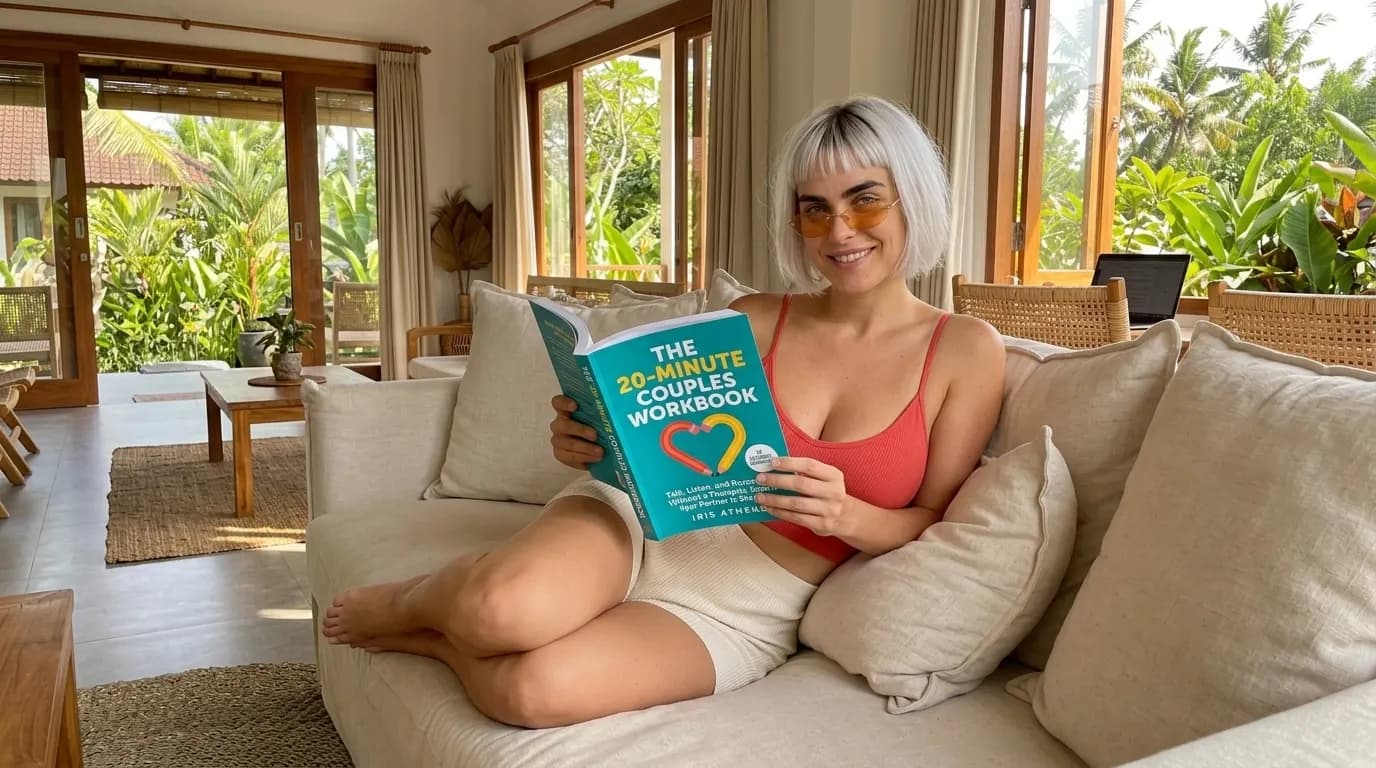
Why “we should talk more” usually backfires
An open-ended talk has no agenda and no end time. So it drifts to the oldest grievance and runs until someone is too tired. You both learn that talking about us goes badly.
A check-in fixes the shape, not the feelings. Same day, same hour, a timer and a page that says what comes next. Nobody has to invent the conversation, and nobody can hijack it.

How is a 20-minute check-in structured?
Five parts, always in the same order, adding up to about twenty minutes.
Check-in (2 minutes)
- What you do
- Each of you writes three quick answers about the week since the last session. Did you get to last week's evening question? One thing you noticed about us. How connected you felt, from 1 to 5. Then you read them out.
- What the evidence says
- The book labels this weekly shape STORY ONLY. It copies the structure that worked in trials: both partners, set times, small steps.
- Try it
- Nobody has to explain a low number. Skip the check-in in week one.
Short reading (about 3 minutes)
- What you do
- One of you reads a short scene and a page called "Why this works" out loud. Partner A reads in odd weeks, Partner B in even weeks, so nobody becomes the teacher.
- What the evidence says
- Each reading carries a label: SOLID, PROMISING or STORY ONLY. Sharing the reading keeps the session from feeling like one partner's project.
- Try it
- Decide now who is Partner A and write it down.

Warm-up (2 minutes)
- What you do
- One light sentence to finish, written alone and read aloud. Something small, such as one thing your partner did this week that you liked.
- What the evidence says
- Gottman and Levenson's lab found that couples who stayed together showed clearly more warmth than negativity, even mid-argument. The book calls this PROMISING: the data show a link, not a cause, and the famous five-to-one figure was an average, not a target.
- Try it
- The listener says only "thank you." Not "that was nothing." Just thank you.
One exercise (12 minutes)
- What you do
- The main part, with timed steps. Some steps you do alone in silence, some out loud. One person writes in the book and the other on a sticky note, so neither peeks.
- What the evidence says
- Couples who did structured, step-by-step programs together at home improved in large randomized trials. Self-help used loosely, now and then, did very little for how happy couples were.
- Try it
- Set a phone timer for each step. The timer, not either of you, decides when a step ends.


Close (2 minutes)
- What you do
- Each of you names one thing you appreciated about the session. Then you stop, even mid-conversation.
- What the evidence says
- Stopping on time is the book's practical rule, not a study result. A twenty-minute session feels safe to start again. An hour that ends in a fight makes the next one harder.
- Try it
- Stop on time in week one, especially if it is going well.
Outside the twenty minutes sits one easy evening question for dinner or the car. No writing, no rules.
Over three years, 11 percent of couples who had one session on paying attention to their relationship broke up, the same as those given 15 hours of skills training, against 24 percent of couples given nothing (Rogge and colleagues, Journal of Consulting and Clinical Psychology, 2013).
That trial does not test a weekly check-in. It does suggest that regular, deliberate attention may matter as much as any single technique.

A first session you can run tonight
This is the book’s first session, “The State of Us,” in short form. It has no complaints in it on purpose.
Session 1, step by step
- Warm-up, 2 minutes. Each of you finishes, alone: “One small thing you did this week that I liked was...” Read them out. The listener says only “thank you.”
- Write in silence, 5 minutes. Set a timer. Each of you writes three things working between you right now. Stick to this month: how you make each other laugh, a thing you handle well as a team, a small routine you both like.
- Read and listen, 5 minutes. Partner A reads all three. Partner B listens, then says which item was a surprise or mattered most to them. Then switch.
- Pick one to protect, 2 minutes. Choose one item from either list and write it as a short sentence that starts with “We.” For example, “We eat dinner together most nights.”
- Close, 2 minutes. Each of you names one thing you appreciated about the twenty minutes. Close the book. Stop here.
Later that evening: ask “What’s one moment from our first year together that still makes you smile?” Listen to the whole answer.
The “We” sentence is your anchor. When a later week gets hard, you both know what you agreed to protect. Before you get up, put next week’s time in both phones.
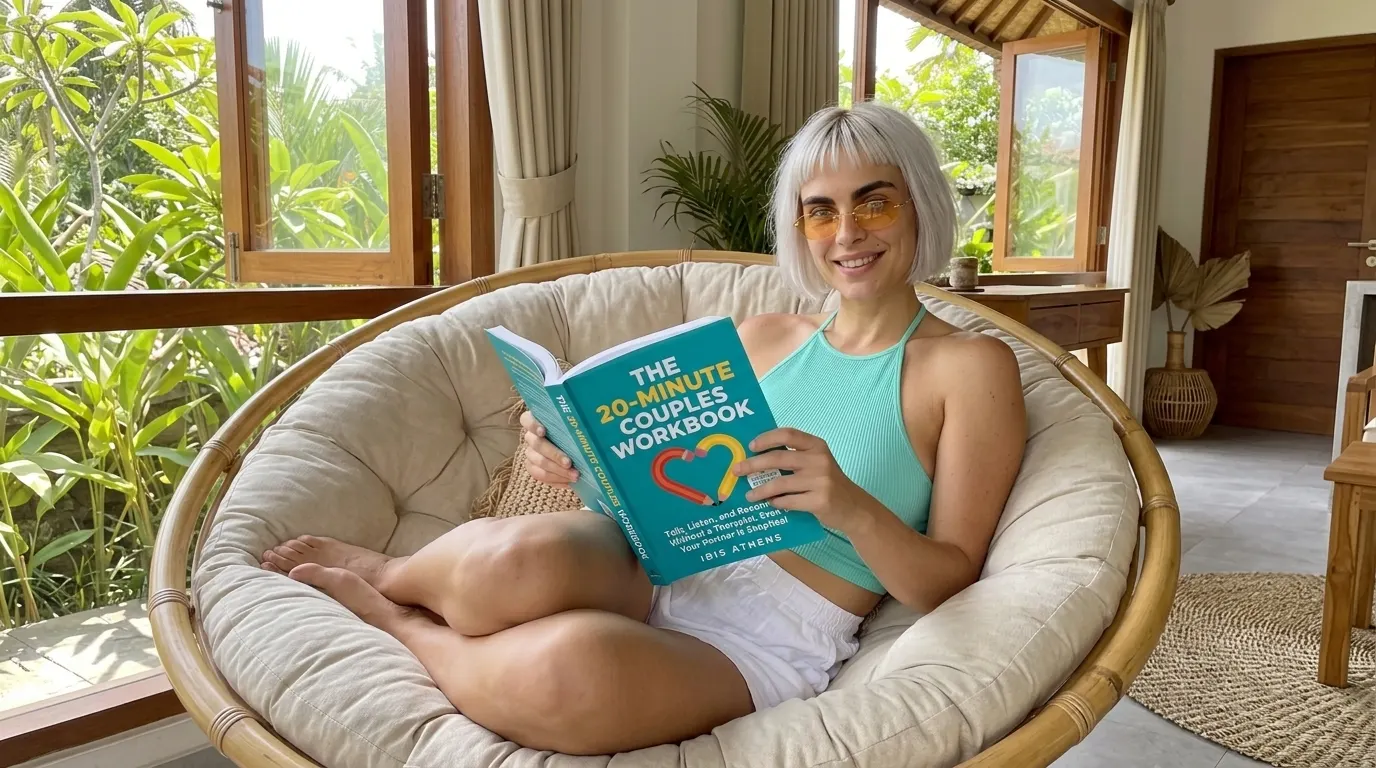
Which rules stop a check-in from turning into a fight?
Five ground rules, agreed before the first session. Any question can be skipped with a plain “pass,” no reason needed. Answers are not evidence for later arguments. Phones stay face down unless one is the timer. The time is fixed. And if it gets heated, you stop.
The pause
- What you do
- Pick one neutral word or hand signal either of you can use. The other person agrees, even mid-sentence. Whoever calls it says when they will be back: “I’m getting flooded. I need a break. I’ll come back at eight.” Take at least 20 minutes and do something calm and a little boring.
- What the evidence says
- In an early-1980s study, couples whose bodies were more stirred up during a disagreement had a bigger drop in satisfaction three years later. The study was small and showed a link, not a cause. The 20-minute break is a practical rule of thumb, labeled STORY ONLY. Venting during the break tends to backfire: in Brad Bushman’s experiment, people who punched a bag while picturing whoever had made them mad came out angrier.
- Try it
- Say your pause sentence out loud once, calmly, while nothing is wrong. If one topic floods either of you twice, save it for next week’s session.
The body-arousal study began with 30 couples, and 19 took part three years later (Levenson and Gottman, Journal of Personality and Social Psychology, 1985).

A break has to be honored. Following a partner who steps away, blocking a door or arguing through the pause is more than a communication problem. See the safety note below.

What if one partner is skeptical?
Make the ask smaller, not louder. Research on couples who look for help finds one partner usually spots the trouble sooner and goes looking for support sooner. That does not make you unreasonable, or your partner difficult.
The invitation
- What they hear
- “We need to work on us” sounds like a list of what is wrong, delivered by the person keeping the list.
- What the evidence says
- Men in unhappy relationships, asked in one study why they stayed away from couples therapy, mostly named feeling no need for it and private shame about asking. In a large randomized trial, a brief, low-pressure relationship checkup left couples closer and less distressed than a waitlist group.
- What to say back
- Something like “Twenty minutes on Sunday, just us, and the first one is only about what is going well. If it is awful we stop.” Pick a calm moment, never mid-argument, and never in front of anyone.
That is why the book’s first three sessions contain no conflict. A doubtful partner who leaves session one thinking “that was fine” tends to come back. One who gets ambushed with complaints does not. Do not skip ahead, even if the hard topic is why you started.
If the answer is still no, ask once more in a few weeks. Reading on your own can help you, but in one study of an online program done by one partner, the relationship itself did not measurably change.

How sure is any of this?
Less sure than most relationship advice sounds. The book labels every idea. SOLID means several good studies agree. PROMISING means real evidence that is thin: one lab, a small sample, or a link without proof of cause. STORY ONLY means it comes from clinical experience and has not been tested directly.
Most session ideas land at PROMISING, and no one has run a trial on this workbook.
The labels also cut the other way. The claim that one lab can predict divorce with 94 percent accuracy is filed under MYTH in the book. When two other researchers tested a similar formula on fresh couples, its accuracy fell from 89.7 to 69.3 percent. A bad check-in is not a forecast.

When a check-in is the wrong tool
Do not do these exercises together if one of you fears the other. Fear counts whether it comes from being hit, pushed or threatened, or from being controlled: phone checking, control of money, deciding who you can see. Talking openly can make home more dangerous when one partner holds power over the other.
- National Domestic Violence Hotline: call 1-800-799-7233, text START to 88788, or chat at thehotline.org
- 988 Suicide & Crisis Lifeline: call or text 988
- In immediate danger: call 911
See a licensed professional instead of, or alongside, a workbook if depression, drinking or an affair is in the picture, or if every session ends in a fight even with breaks.
The book written for this problem
 The 20-Minute Couples Workbook on Amazon (opens in a new tab)
by Iris Athens
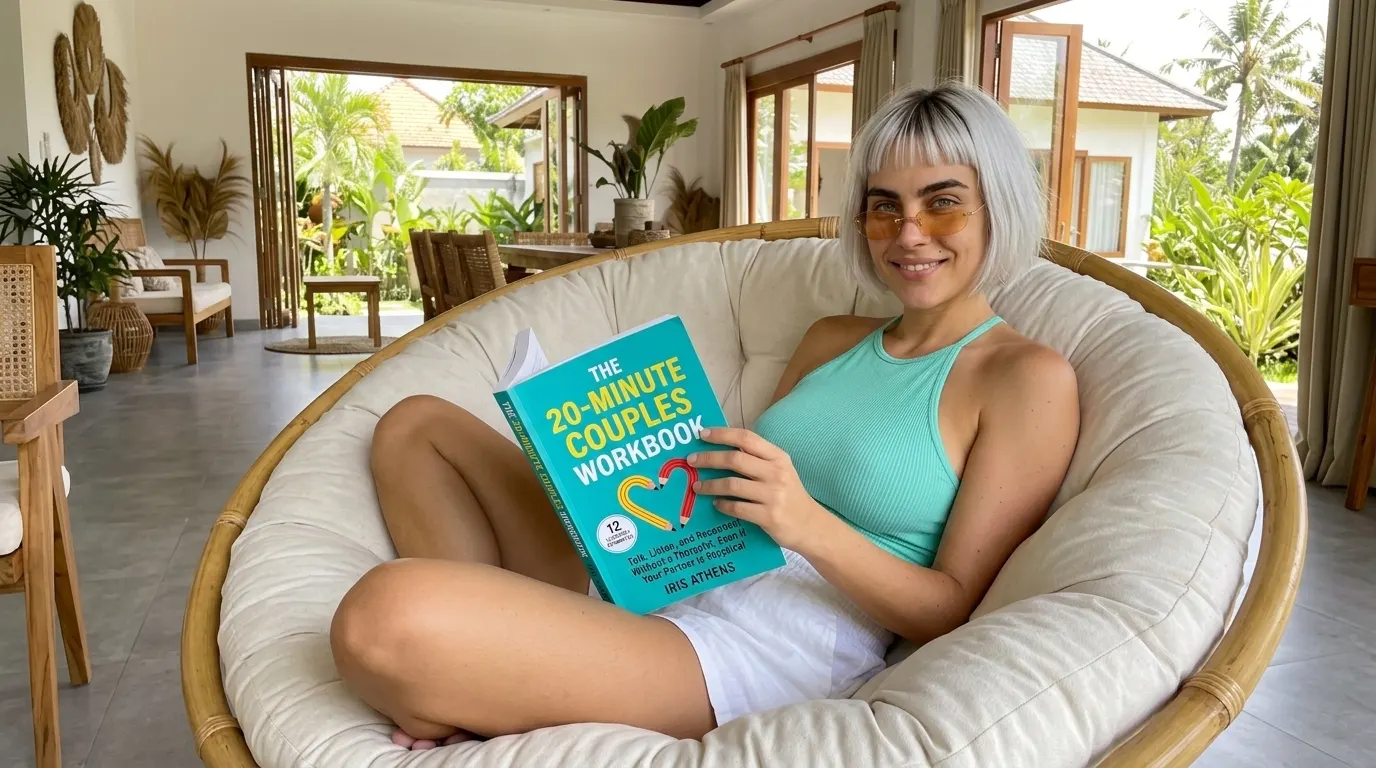
The 20-Minute Couples Workbook by Iris Athens is a 154-page workbook with twelve guided sessions, one a week, done together with one book and two pens. Every exercise has side-by-side space for Partner A and Partner B.
It ends with 52 questions for the kitchen table, a page of repair phrases and a one-page flooding plan. The author is not a therapist, and the book says so.
- How This Book Works: the five-part session shape, the sticky-note rule and the ground rules
- For the One Who Bought This Book: how to ask a skeptical partner, with sample lines and what to do after a no
- The State of Us: the full first session given in short form above
- When You're Flooded: making a break plan in a calm moment: signs, signal, who restarts
- Myth Check: eight popular claims, from the 94 percent divorce figure to venting, checked against studies

It fits if
- Your talks feel quiet, not angry
- You want structure but cannot afford therapy, or do not want it
- Your partner is doubtful and needs a small, low-stakes first step
Skip it if
- One of you fears the other
- You want therapy or a diagnosis
- One of you has decided to leave and the other wants to stay
Fair doubts
“Scheduling a talk feels unromantic.”
It can, for a week or two. But unscheduled talks wait until someone is upset. A fixed time means neither of you has to be the one who says “can we talk.”
“Can we not just use a list of questions?”
You can. A list gives you topics but no shape: when to stop, how to pause, what to do with a hard answer. The structure keeps it from turning into another late-night argument.
Questions couples ask about weekly check-ins
What should a couple talk about in a weekly check-in?
Start with how the week felt, not with problems. A few quick lines, such as one thing you noticed about each other and how connected you felt from 1 to 5, then one short exercise. Save complaints for later sessions, once the routine feels safe.
How long should a relationship check-in take?
About 20 minutes is a common target. The book uses 2 minutes of check-in, a short reading, a 2-minute warm-up, a 12-minute exercise and a 2-minute close.
What if my partner calls a break and I want to keep talking?
Let the break happen, even mid-sentence. Agree in advance that whoever calls it says when they will be back, and hold on to that time. Use the wait to calm down, not to plan your reply.
Why won't my partner work on the relationship with me?
Often it is not about how happy they are. When one study asked men in unhappy relationships why they stayed away from couples therapy, most said they felt no need for it or felt privately ashamed to ask for help. A smaller invitation helps: twenty minutes, once, starting with what is going well.
Can we use a couples workbook and therapy at the same time?
Yes. The book suggests a professional instead of, or alongside, it when depression, drinking or an affair is involved, or when every session ends in a fight. If one partner fears the other, skip the joint exercises and contact the National Domestic Violence Hotline first.
Should you never go to bed angry?
No study shows that settling every fight before bed protects a relationship, and couples argue worse when they are tired. A better rule is not to go to bed disconnected. Say something like "I love you. Let's pick this up tomorrow at seven," then really pick it up at seven.
Sources
- Rogge and colleagues, Is skills training necessary for the primary prevention of marital distress and dissolution?, Journal of Consulting and Clinical Psychology (2013)
- Cordova and colleagues, The Marriage Checkup: a randomized controlled trial, Journal of Consulting and Clinical Psychology (2014)
- McAllister, Duncan and Hawkins, Self-directed marriage and relationship education: a meta-analytic study, Family Relations (2012)
- Levenson and Gottman, Physiological and affective predictors of change in relationship satisfaction, Journal of Personality and Social Psychology (1985)
- Spiker, Hammer and Parnell, Men in unhappy relationships: perceptions of couple therapy, Journal of Social and Personal Relationships (2019)
- National Domestic Violence Hotline, guidance on couples therapy with an abusive partner (checked October 21, 2026)
- The 20-Minute Couples Workbook by Iris Athens: How This Book Works, For the One Who Bought This Book, Before You Start, The State of Us, When You’re Flooded, Myth Check
