Updated: October 22, 2026
You Have No Idea What ChatGPT Tells Customers About Your Business. Here Is How to Find Out in One Sitting.

Short answer
You find out by asking the AI tools the way a customer would. Write three questions in your customer’s words and ask each one on ChatGPT, Claude, Perplexity and Google’s AI. Note if you show up, which names show up in your place and what each tool believes about you. Then give your business 0 to 2 on five checks: access, a clear label, trust, quotable answers and matching the way customers ask. The lowest score is where you start.
Why run this check before anything looks wrong?
Because you will not get a warning when it goes wrong. Nobody emails you when a chatbot names three other businesses in a private conversation. The customer just books one of them.
Picture a regular client who forgets he already has you. He asks ChatGPT for someone in your line of work, and it names strangers. You only hear about it if he happens to mention it over coffee. Most owners never hear about it at all.
Your sales may look fine today. Referrals still come in. That is exactly when the check is cheap: you have time to fix a gap before it shows up in the numbers.

Why searching your own name tells you almost nothing
Typing your business name into Google shows you that you exist. It does not show you whether an AI names you when someone describes a problem and never mentions you. That is the question that brings in new customers, and it is the one most owners never test.
The answer box is where many people now stop. A Pew Research Center study of real browsing found that people clicked far fewer links when a Google AI summary appeared.
With an AI summary on the page, people clicked a regular result on 8% of visits, against 15% with no summary, and tapped a link inside the summary on just 1% (Pew Research Center, 2025).
Local search moved the same way, and fast.
By 2026, close to half of US consumers said they had turned to AI tools when looking for a local business, against a small fraction one year before (BrightLocal, 2026).
Ranking well is not a stand-in either. An Ahrefs study of AI Overview citations found that pages ranked in Google’s top ten went from about 76% of cited sources to roughly 38%. You have to look at the answers themselves.
Step 1: Write three questions the way your customer would say them
Your questions decide what the check can see, so write them in your customer’s words, not your trade’s. Use these three shapes and fill in the blanks for your business.
- The problem question. “I have [the customer’s problem]. Do I need [what you offer], and how do I find a good one?”
- The who question. “Who’s a good [your role] for [your ideal customer] in [your area]?”
- The choosing question. “What should I look for when choosing a [your role]?”
For the first one, borrow a real sentence. Open your inbox and read the first lines of recent inquiries, the ones written before the client learned your jargon. A bookkeeper might find “I switched to full-time freelance, what do I do about my books?” That beats “bookkeeping services” every time.

Step 2: Ask all three on four tools
Ask the same three questions on ChatGPT, Claude, Perplexity and Google’s AI Overviews or AI Mode. Twelve answers take a few minutes to collect. Copy each one into a document as you go, because you will compare them later.
Then add one direct request on each tool: “Describe [your business name].” Give it your web address if it asks. This is the fastest way to see the label the machine has written for you.
Watch the follow-up questions the tools suggest under their answers, too. Those suggestions reflect how people phrase the topic. Write down any that fit your business; you will use them in Step 5.

Step 3: Read each answer for three things
For every answer, write down three facts and nothing else yet. Did you appear? Who appeared instead? What did the tool seem to know, or not know, about you?
Be literal. “Named, third of three, called a financial consultant” is a useful note. “Sort of there” is not. Copy the exact words the tool used about you, because wrong words point straight at the problem.
Look at who got named, without envy. Are they bigger, or just clearer about what they do? Do other sites mention them? That comparison often tells you more than your own row does.

Step 4: Score yourself on the five checks
An AI names a business only after five quiet checks pass. Score each one: 2 if it clearly passes, 1 if it partly does, 0 if it fails. Use what you saw in the answers and the quick test on your own site.
| Check | What failing looks like in the answers | Quick test on your own site | Your score (0 to 2) |
|---|---|---|---|
| 1. Can it find you? | You never show up, in any tool, for any of your three questions. | Open yoursite.com/robots.txt. No Disallow line should name GPTBot, ClaudeBot or PerplexityBot. Then view the page source and search it for one real sentence about your business. | ___ |
| 2. Can it tell what you are? | You show up, but described vaguely or in the wrong trade. | Ask each tool to describe your business. Does the answer say what you do, who it is for and where, in plain words? | ___ |
| 3. Will it vouch for you? | It names competitors who are no better than you, and not you. | List every site you do not own where your name appears: independent reviews, a byline, a real directory listing, a forum answer. Is a named person shown on your site? | ___ |
| 4. Can it quote you cleanly? | Your site appears as a source, but none of your sentences make it into the answer. | Copy the first sentence of your best answer onto a blank page. Does it still answer the question with nothing around it? | ___ |
| 5. Do you match how people ask? | You appear when you type your trade's term, not when you type the customer's problem. | Put your page headings next to the three customer questions you wrote. Does any heading use their words? | ___ |
Add the five scores for a total out of 10. The total is only a way to compare with next month. The row scores matter more, because each one points at a different fix.
Two notes on the first row. A privacy plugin or a “block AI scrapers” setting can add those Disallow lines without you noticing. And blocking AI training is not the same choice as allowing AI search, even though some tools lump them together.

Step 5: Fix the lowest score first, and fix in order
Start with your lowest row. If two rows tie, take the one higher up the table. The checks stack: being quotable is no use if the AI cannot read your page, and trust does not help if it cannot tell what you do.
- Low on finding you: remove the AI bot blocks, and make sure your services and tagline are real text you can highlight, not words baked into an image.
- Low on what you are: write one plain sentence with what you do, who it is for and where. Put it at the top of your homepage and in every profile, in nearly the same words.
- Low on trust: put a named person and real years of experience on the site. Then earn one outside mention, such as an honest review or a useful piece under your name in a newsletter your clients read.
- Low on quoting: rewrite your three key answers so the first sentence is the answer, stands alone and makes one clear claim.
- Low on the real question: write one page whose title is a question from your Step 1 list or from the follow-ups the tools suggested.
Pick one row and go deep. A business that fully fixes its weakest check usually moves further than one that does a quick pass on all five.
Step 6: Run it again in 30 days
Same three questions, same four tools, same scorecard. Put the two sets of notes side by side. A changed word in how the AI describes you counts as progress, even before it names you first.
After that, repeat every few months. Read your newest inquiries and add any new customer questions to the list. Tax deadlines, new rules and new software all create new questions, and your list should keep up with them.

The book behind the five checks
 Found by AI on Amazon (opens in a new tab)
by Ismail Gunaydin
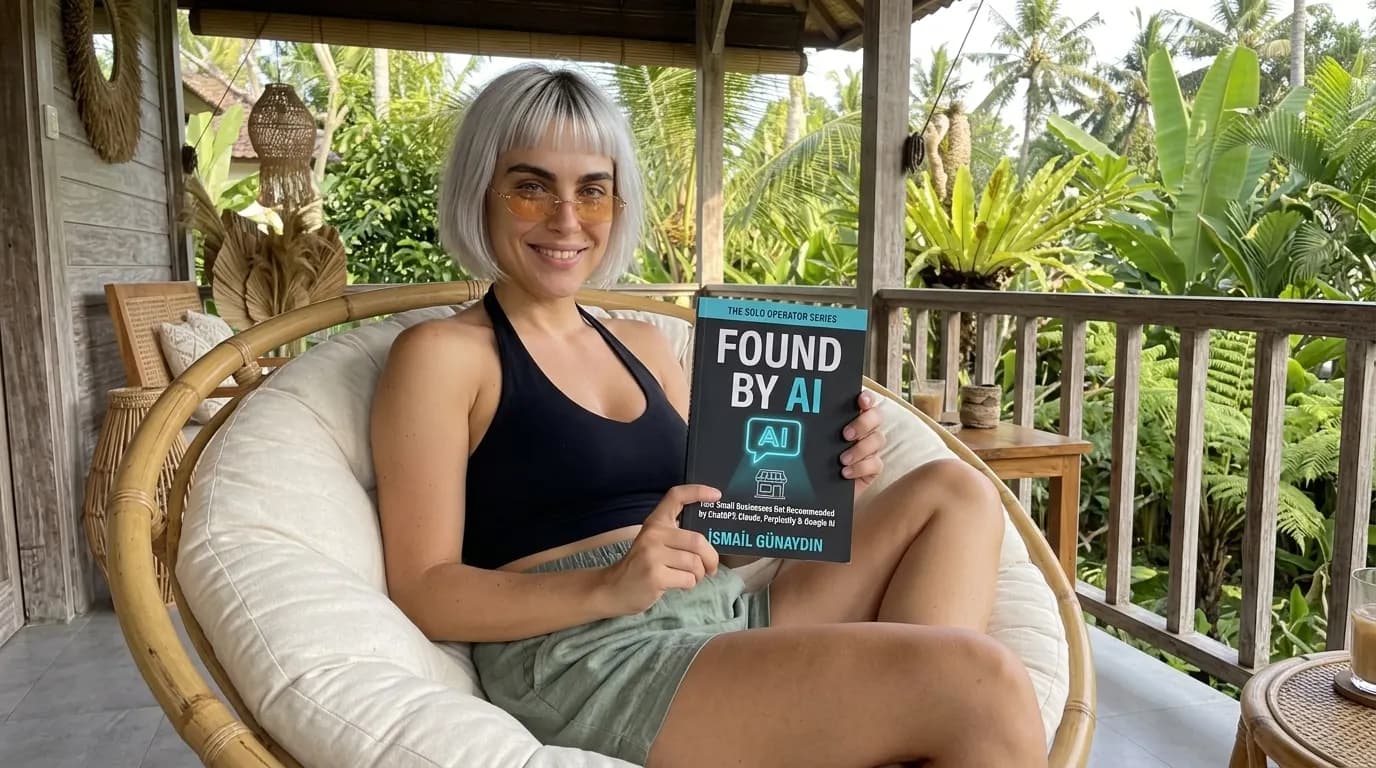
Found by AI is a 70-page book built on five questions an AI asks before it names a business. It comes with seven one-page tools, starting with the opening snapshot. It is part of The Solo Operator Series. The author, Ismail Gunaydin, is our founder.
This page gives you the snapshot and a short version of each check. The book adds worked examples for every check, the chapters on quotable answers and on mapping real customer questions, and the full 30-day plan.
- Introduction: The New Front Door: the four-minute snapshot this check is built on, and how to read the result
- Can I Even Find You?: the four access checks, from robots.txt to text trapped in images
- Can I Tell What You Are?: the three facts and one sentence that give the AI a clear label
- Do I Trust You Enough to Name You?: the three kinds of trust signal and how to earn each one honestly
- Conclusion: The 30-Day Visibility Build: the five checks paced across a month, with a re-check on day 30
It fits if
- A chatbot recommended three rivals when you asked for someone in your trade
- Your boss handed you “AI search” as a project and gave you no budget for it
- You want Perplexity and Claude to quote your site, and you want a plan in order
Skip it if
- You lead a large SEO team that already pays for tracking software
- You want tricks to game AI answers rather than be easy to read and trust
- You want a long technical manual; this one is short and plain on purpose
Fair doubts
“The answers change every time I ask.”
They can. That is why the check uses three questions on four tools instead of one. You are looking for a pattern across twelve answers, not a verdict from a single one.
“Can I not just add an llms.txt file?”
You will hear that pitch often. Senior Google engineers have said on the record that Google does not read it, and likened it to a long-dead meta tag. Spend the hour making your real homepage readable instead.
“Is this not just SEO with a new name?”
Part of it overlaps, such as a readable site. But the pages AI tools cite often do not rank near the top of Google, so a good ranking does not prove you are named. Only the answers tell you that.
Questions people ask about AI and their business
How can I get ChatGPT to recommend my business?
Start by checking which of five things is missing. The AI has to be able to reach your site, tell what you do, trust you enough to name you, lift a clean sentence from your page and match the way customers ask. Ask it three questions a customer would ask, score each check, and fix the weakest one first. There is no setting or file that buys a recommendation.
Do reviews help ChatGPT recommend my business?
They help as one outside voice. Your own website is your word about yourself, so an AI looks for someone else saying you are good: reviews on a platform you do not own, a mention in a newsletter, a listing in a directory your field uses. Ask happy clients to review you, but never tell them what to write.
Is AI SEO called GEO?
Often, yes. GEO stands for generative engine optimization, and people also say AEO or AI SEO for the same goal: being named and quoted inside AI answers, not only ranked in a list of links. The check on this page works whatever you call it, because it starts from what the answers actually say about you.
Will GEO replace SEO?
Not cleanly. Pages that AI tools cite often do not rank in Google's top ten, so the two do not always move together. A readable site, a clear description of what you do and real outside mentions help with both. Keep the basics working and add the AI check to your routine.
How often should I check what AI says about my business?
Run the full check once, fix the weakest area, and run it again after about 30 days to compare. After that, look again every few months. Customer questions shift with seasons and new problems, so add new ones from your inbox to your list each time.
Sources
- Pew Research Center, study of clicks on Google pages with and without an AI summary (July 2025)
- BrightLocal, research on consumers using AI to find local businesses (2026)
- Ahrefs, AI Overview citations and the top 10
- Found by AI by Ismail Gunaydin, introduction, chapters 1 to 5 and conclusion
