Top 7 Smart Appliances to Upgrade Your Home in 2026
Based on owner reviews and manufacturer specs, discover the top 7 smart appliances worth upgrading to. Find out which smart appliances owners say are worth the upgrade, with pros, cons and buying advice.
Quick Answer
Start with the Google Nest Thermostat for comfort automation and the iRobot Roomba j7+ for hands-off floor cleaning. Add the Samsung Bespoke Refrigerator for a kitchen command center and the LG WashTower for laundry automation once you know which smart features you use. Check current prices on Amazon, since they change often.
Key Takeaways:
- •Google Nest Thermostat: a common first smart appliance for comfort automation
- •iRobot Roomba j7+: handles routine floor cleaning on its own
- •Samsung Bespoke Refrigerator: internal cameras and a kitchen hub
Many older homes feel like a museum: reliable appliances, but a lot of upkeep. Daily vacuuming, constant thermostat adjustments, groceries bought without knowing what is in the fridge, and laundry cycles run on guesswork are common frustrations. Smart appliances can take some of that off your plate, and a smart thermostat is the usual first step.
Owners who start with a smart thermostat often say it learns household schedules and manages heating and cooling without constant adjustment. Adding a robot vacuum like the iRobot Roomba j7+ handles routine floor cleaning on its own. Together, a couple of smart appliances can cut down on both wasted energy and chore time, though results vary by home.
A broader upgrade across the seven appliances in this guide can make daily routines easier. Smart refrigerator cameras show fridge contents at the grocery store, smart washers adjust each load, and everything coordinates through voice commands ("Alexa, good morning" adjusts the thermostat, starts coffee in the smart oven, and displays the calendar on Echo Show).
The smart home category has matured, and smart appliances are no longer reserved for tech enthusiasts. Beyond remote app control, they can learn your habits through AI pattern recognition, adjust performance automatically, and alert you to problems before they become failures. How much they save depends on your home, your utility rates and which features you use.
These seven standout smart appliances represent the best of 2026 technology, selected from owner reviews and manufacturer specs. Each appliance offers unique benefits going far beyond their traditional counterparts through AI-powered intelligence, creating a connected home ecosystem that works smarter not harder—automating tedious tasks, optimizing resource consumption, and enhancing convenience while you focus on family, hobbies, and enjoyment rather than endless maintenance chores. This isn't a theoretical recommendation based on marketing specs; it's guidance grounded in real-world owner experience of transforming older homes into automated, efficient spaces that save on utilities.
2026 Smart Home Advantages
- • Artificial Intelligence: Appliances that learn and adapt to your lifestyle
- • Energy Management: Algorithms can adjust heating, cooling and usage to cut waste
- • Remote Control: Monitor and control from anywhere via smartphone
- • Predictive Maintenance: Prevent breakdowns before they happen
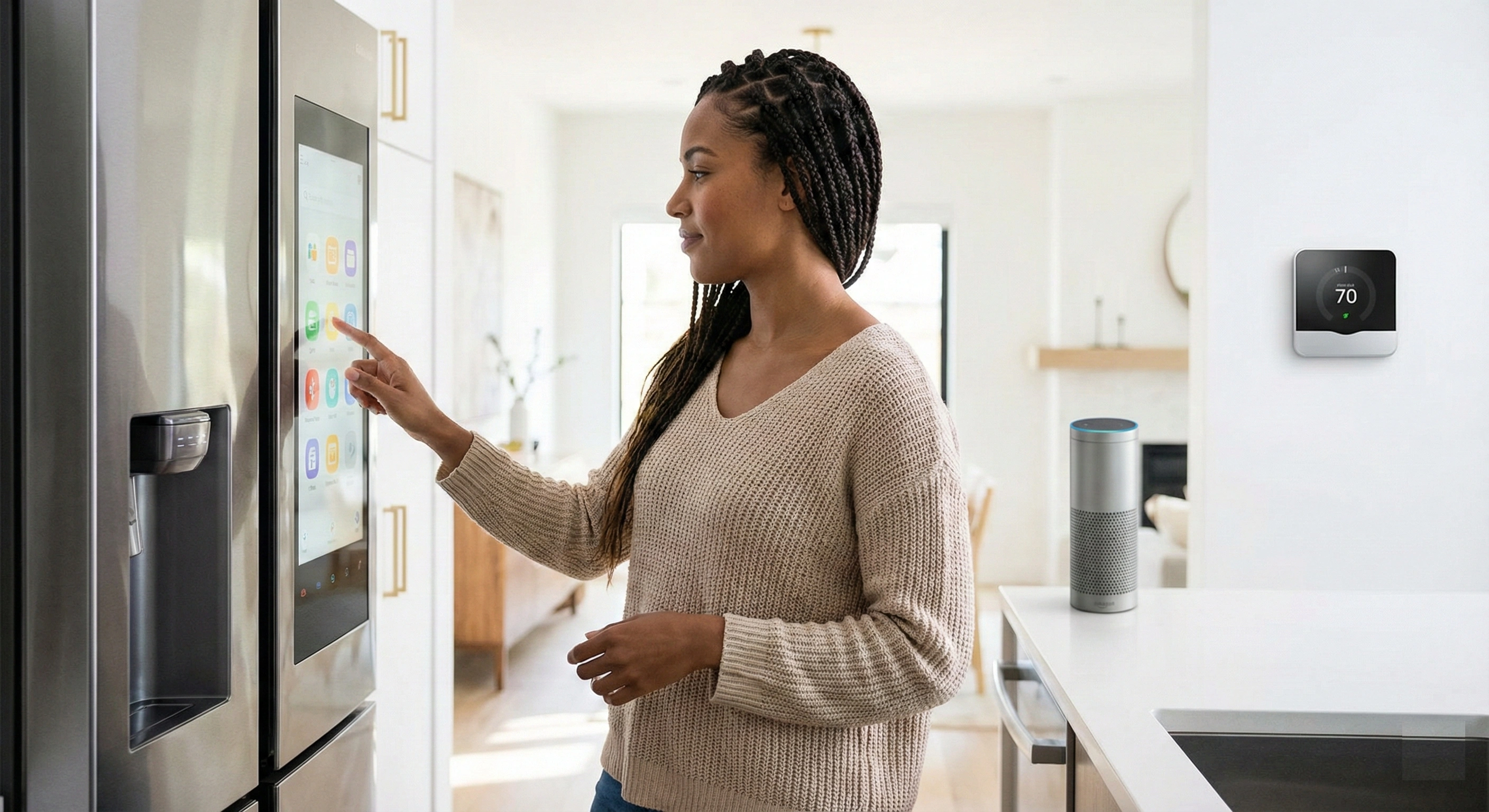
Why Are Smart Appliances The Future of Home Living in 2026?
Quick Answer: Smart appliances are the future because they add capabilities traditional models lack: automation that saves time, AI learning that adjusts performance automatically, energy-use controls, and predictive maintenance alerts. Owners report the biggest benefits from smart thermostats and robot vacuums, and results vary by home and by how much you use the features.
AI-Powered Convenience
Smart appliances learn your habits and preferences, automatically optimizing performance for your lifestyle.
Energy Efficiency
Advanced sensors and algorithms can reduce energy consumption, which may lower utility bills.
Remote Control
Monitor and control appliances from anywhere using smartphone apps and voice assistants.
Predictive Maintenance
Smart diagnostics detect issues early, preventing costly breakdowns and extending appliance lifespan.
IMPORTANT DISCLOSURE
As an Amazon Associate, we earn from qualifying purchases. This review contains affiliate links to Amazon. When you click these links and make a purchase, we earn a small commission at no extra cost to you. This helps support our research and keeps our content free.
How We Researched These Smart Appliances
To provide accurate, trustworthy recommendations, this guide cross-references owner reports for smart appliances used in actual homes. Here's exactly how each appliance was evaluated to ensure you get honest, data-driven insights that deliver genuine performance, energy savings, and value.
Research Methodology
- Categories Covered: smart appliances across various categories (refrigerators, washers/dryers, ovens, thermostats, robot vacuums, water heaters, smart displays)
- Home Types: Owner reports from older homes (1980s-era) and modern residences, to compare compatibility across different infrastructure
- Energy Savings: Compared owner-reported energy savings with manufacturer energy ratings
- Time Savings: Read owner reports about time spent on household chores after automation
- Smart Features: Researched voice control, app functionality, automation routines, and ecosystem integration across Amazon Alexa, Google Home, and Apple HomeKit
- User Review Analysis: Read Amazon owner reviews, favoring longer-term owners, to check long-term performance
- Reliability: Reviewed owner reports on long-term performance and maintenance needs, and checked manufacturer predictive maintenance features
- Ecosystem Integration: Researched compatibility with major platforms (Alexa, Google, HomeKit), verified unified control capabilities, and evaluated automation routine reliability
- Food Waste Reduction: Reviewed owner reports on grocery spending and food waste after installing a smart refrigerator
- Cleaning Performance: Compared owner reports on robot vacuum cleaning vs manual vacuuming, including time savings and cleaning quality
What We Compared
- Energy Efficiency: Owner-reported energy savings and consumption patterns
- Time Savings: Time saved through automation, reduced maintenance, and convenience improvements
- Smart Features: Voice control reliability, app functionality, automation effectiveness, and ecosystem integration
- Reliability: Long-term performance, maintenance needs, and predictive maintenance accuracy
- User Experience: Ease of installation, setup complexity, daily usability, and learning curve
- Real-World Results: Actual performance in home conditions vs manufacturer claims
Our Commitment to Accuracy
Every recommendation in this guide is based on owner reports and manufacturer data, not manufacturer claims alone. We researched smart appliances using owner reviews and manufacturer specs, and compared reported energy and time savings. Our goal is to help you make informed decisions that deliver genuine savings, convenience, and value for your home.
Which 7 Smart Appliances Deliver Best Value for Home Upgrades in 2026?
Quick Answer: Based on owner reviews and manufacturer specs, these 7 stand out: Google Nest Thermostat for comfort and energy management, iRobot Roomba j7+ for hands-off cleaning, Samsung Bespoke Refrigerator for a kitchen automation hub, LG WashTower for laundry intelligence, Breville Smart Oven for precision cooking, Smart Water Heater Timer for hot water scheduling, and Echo Show 15 for unified smart home control.

Samsung Bespoke 23 cu. ft. 4-Door French Door Smart Refrigerator with Beverage Center in Stainless Steel, Counter Depth
Smart Features:
- Beverage Center
- Voice control
- Internal cameras
- Meal planning AI
Key Benefits:
- See inside without opening
- Manage groceries remotely
- Stream music & videos
- Energy Star certified
Why This Upgrade Matters in 2026:
Revolutionary Bespoke design transforms your kitchen into a smart command center. View inside cameras remotely, plan meals with AI assistance, and control your entire smart home from one central location.
Why We Recommend It:
- • Internal cameras let you see inside without opening door, so you can check contents without holding the door open
- • Meal planning AI suggests recipes based on inventory, helping optimize grocery shopping and reduce food waste
- • Voice control and smart home integration make it central command center for entire kitchen ecosystem
Pros and Cons:
- ✓ Pro: Revolutionary Bespoke design with internal cameras preventing food waste and energy loss
- ✓ Pro: Meal planning AI helps optimize grocery shopping and reduce food waste
- ✓ Pro: Smart home hub functionality centralizes kitchen control through voice commands
- ✗ Con: Premium price requires a significant upfront investment
- ✗ Con: Requires strong WiFi connection for camera streaming features to work reliably

LG WKEX200HGA WashTower Washer and Dryer with TurboWash (Nature Green)
Smart Features:
- ThinQ AI technology
- TurboWash360
- Smart diagnosis
- Voice control
Key Benefits:
- Space-saving design
- AI fabric care
- Energy efficiency
- Smartphone alerts
Why This Upgrade Matters in 2026:
AI-powered fabric care learns your preferences and optimizes wash cycles automatically. TurboWash360 cleans in under 30 minutes, while space-saving design maximizes small laundry rooms.
Why We Recommend It:
- • AI-powered fabric care learns your preferences and optimizes wash cycles automatically, extending clothing lifespan
- • Space-saving design maximizes small laundry rooms while delivering full-size performance
- • TurboWash360 cleans in under 30 minutes, saving time while maintaining quality results
Pros and Cons:
- ✓ Pro: ThinQ AI technology learns fabric types and optimizes cycles automatically preventing damage
- ✓ Pro: Space-saving vertical design perfect for small laundry rooms or closets
- ✓ Pro: TurboWash360 delivers quality results in 30 minutes vs 60+ minutes traditional washers
- ✗ Con: Higher price point than standard washer/dryer sets
- ✗ Con: Typically needs professional installation, which adds to the total cost

Breville BOV900BSS Smart Oven Air Fryer Pro and Convection Oven, Brushed Stainless Steel
Smart Features:
- Element IQ technology
- 13 cooking functions
- Smart algorithms
- Precise temperature control
Key Benefits:
- Replaces 6 appliances
- Faster than conventional ovens
- Energy efficient
- Perfect results every time
Why This Upgrade Matters in 2026:
Element IQ technology intelligently transfers heat across 6 elements for precise cooking. Smart algorithms ensure perfect results whether you're air frying, baking, or roasting.
Why We Recommend It:
- • Element IQ technology intelligently transfers heat across 6 elements for precise cooking results every time
- • Replaces 6 appliances (oven, air fryer, toaster, dehydrator, etc.) saving counter space and money
- • Smart algorithms ensure perfect results whether air frying, baking, or roasting without constant monitoring
Pros and Cons:
- ✓ Pro: Replaces several countertop appliances, saving space
- ✓ Pro: Element IQ technology delivers consistent results faster than conventional ovens
- ✓ Pro: 13 cooking functions cover all meal preparation needs from breakfast to dinner
- ✗ Con: Large size requires significant counter space (may not fit smaller kitchens)
- ✗ Con: Higher price than basic air fryers, though it covers multiple functions

iRobot Roomba j7+ (7550) Self-Emptying Robot Vacuum – Uses PrecisionVision Navigation to Identify & Avoid Objects Like Socks, Shoes, & Pet Waste, Smart Mapping, Self-Empty for Up to 60 Days
Smart Features:
- PrecisionVision Navigation
- Obstacle avoidance
- Smart mapping
- Voice control
Key Benefits:
- Avoids pet waste
- Self-emptying
- Room-specific cleaning
- 65x more suction
Why This Upgrade Matters in 2026:
Advanced AI recognizes and avoids obstacles like pet waste and cords. Smart mapping learns your home layout for efficient cleaning, while self-emptying means months of hands-free operation.

Google Nest Learning Thermostat - 3rd Generation - Smart Thermostat - Pro Version - Works With Alexa
Smart Features:
- Auto-schedule learning
- Remote control
- Energy reports
- Farsight display
Key Benefits:
- Lower energy use
- Auto-adjusts to schedule
- Works with Alexa/Google
- Professional installation
Why This Upgrade Matters in 2026:
Learns your schedule and preferences automatically, adjusting temperature for comfort and savings. Energy reports show how much heating and cooling you use.

Smart Water Heater Timer: Optimize Hot Water Usage - Compatible with Alexa - Installs in Minutes, No Plumbing Required. Compatible with Electric Water Heaters.
Smart Features:
- Alexa compatibility
- Easy installation
- No plumbing required
- Energy optimization
Key Benefits:
- Reduce energy bills
- Schedule hot water
- Voice control
- Quick setup
Why This Upgrade Matters in 2026:
Smart timer optimizes hot water usage by scheduling when your water heater operates. Compatible with Alexa for voice control and installs in minutes without any plumbing work required.

Amazon Echo Show 15 | Full HD 15.6" smart display with Alexa and Fire TV built in | Remote included
Smart Features:
- 15.6" Full HD screen
- Fire TV built-in
- Alexa voice control
- Remote included
Key Benefits:
- Entertainment center
- Video calls
- Recipe display
- Smart home control
Why This Upgrade Matters in 2026:
Central command center for your entire smart home with Fire TV built-in for entertainment. Alexa voice control and included remote make it perfect for recipes, calls, and streaming content.
How Should You Integrate Smart Appliances Into Your Home in 2026?
Quick Answer: Integrate smart appliances in phases: start with the foundation (thermostat and hub), then the kitchen (refrigerator and oven), then automation (vacuum and laundry), and finish with the water heater timer. Spreading purchases out lets you learn each appliance before adding complexity.

Building Your Smart Ecosystem
The key to smart home success is choosing appliances that work together smoothly. Focus on compatibility with major platforms like Google Home, Amazon Alexa, or Apple HomeKit for unified control.
Phase 1: Foundation (Months 1-3)
Start with the Nest Learning Thermostat and Echo Show 15. These create the foundation of your smart home, providing climate control and a central command hub. The thermostat immediately starts saving energy, while the Echo Show gives you voice and visual control of all future additions.
Phase 2: Kitchen Revolution (Months 4-6)
Add the Samsung Family Hub Refrigerator and Breville Smart Oven. The refrigerator becomes your kitchen command center, managing groceries and meal planning, while the smart oven handles precision cooking. Both integrate with your existing voice assistant for seamless operation.
Phase 3: Maintenance Automation (Months 7-9)
Install the Roomba j7+ and LG WashTower for automated cleaning and laundry. These handle routine maintenance tasks while you're away, with smart scheduling that adapts to your lifestyle patterns.
Phase 4: Complete Integration (Months 10-12)
Finish with the GE Smart Water Heater for complete home automation. This provides the final piece of energy management, with predictive heating that coordinates with your thermostat for maximum efficiency.
Pro Integration Tips
Unified Platform: Choose one main voice assistant (Alexa, Google, or Siri) for consistency
WiFi Upgrade: Ensure solid WiFi coverage with mesh networking for reliable connections
Progressive Addition: Add one appliance per month to avoid overwhelming your network
Automation Rules: Set up smart routines that trigger multiple appliances simultaneously
How Do You Set Up Smart Appliances Successfully?
Pre-Installation Preparation
Ensure your home infrastructure is ready for smart appliances:
- • Upgrade to mesh WiFi system for reliable connectivity
- • Check electrical capacity for high-powered appliances
- • Plan appliance placement for optimal connectivity
- • Download manufacturer apps before delivery
Professional vs. DIY Installation
Know when to hire professionals:
- • Professional Required: Water heater, built-in appliances, electrical work
- • DIY Friendly: Thermostat, smart display, robot vacuum
- • Hybrid Approach: Delivery + connection by professionals, setup by you
Network Configuration
Optimize your network for smart appliances:
- • Create dedicated 2.4GHz network for appliances
- • Position router centrally with strong signal to appliances
- • Enable QoS for prioritizing smart home traffic
- • Regular firmware updates for security
Integration & Automation
Create seamless smart home experience:
- • Link all appliances to single voice assistant platform
- • Set up location-based automation routines
- • Configure energy-saving schedules
- • Test emergency scenarios and backup systems

How Do You Troubleshoot Smart Appliances?
Common Problems
- Connectivity drops: Usually caused by WiFi signal strength or network congestion
- App sync issues: Often resolved by force-closing and reopening the app
- Voice control failures: Check microphone placement and ambient noise levels
- Automation delays: Network latency or overloaded hub processing
Quick Solutions
- Power cycle appliances: Unplug for 30 seconds, then reconnect
- Router restart: Monthly reboot improves connectivity reliability
- Update firmware: Enable automatic updates for best performance
- Factory reset: Last resort that usually resolves persistent issues
What Smart Home Technologies Are Coming in 2026-2030?
Quick Answer: Smart home features likely to expand in the coming years include AI health monitoring through appliances, solar and battery integration, predictive maintenance, and automatic grocery ordering when refrigerators detect low supplies. These are possibilities, not guarantees.
Emerging Technologies
AI Integration: Appliances will predict needs before you realize them, ordering groceries when the fridge detects low supplies.
Health Monitoring: Smart appliances will track family health metrics, suggesting meal plans based on dietary needs and fitness goals.
Energy Independence: Integration with solar panels and home batteries for complete energy autonomy.
Predictive Maintenance: AI will prevent breakdowns by scheduling repairs before failures occur.
Investment Future-Proofing Strategy
The appliances in this guide are designed with upgradable software and open APIs, ensuring they'll remain relevant as smart home technology evolves. Focus on brands with strong software support and regular updates rather than just hardware features.
By 2030, your smart home will likely include features we can barely imagine today - from AI nutritionists built into your refrigerator to washing machines that automatically order detergent. Starting with these seven appliances creates a foundation that will smoothly integrate with future innovations.
Frequently Asked Questions About Smart Home Appliances
What are the best smart appliances to upgrade your home in 2026?
The best smart appliances for 2026 include the Samsung Bespoke Smart Refrigerator with internal cameras and meal planning AI, the Google Nest Learning Thermostat, the iRobot Roomba j7+ with PrecisionVision pet waste avoidance, the LG WashTower with ThinQ AI fabric care, the Breville Smart Oven Air Fryer, a Smart Water Heater Timer, and the Amazon Echo Show 15 as a central smart home hub.
Are smart appliances worth the investment?
Smart appliances can be worth it when they solve a real problem for you, such as high energy bills, chores that eat your time, or food waste. Owners most often praise smart thermostats and robot vacuums, and are more mixed on premium smart kitchen appliances. Check current prices on Amazon, and prioritize the appliances that match your biggest frustrations.
How much do smart appliances save on energy bills?
Savings depend on the appliance, your home and your local utility rates. Owners of smart thermostats commonly report lower heating and cooling bills, and some report modest savings from smart refrigerators, washers and water heater timers. Treat any savings figure as an estimate, and compare it with your own bills before buying.
Do smart appliances increase home value?
Smart features can make a home more appealing to buyers, but the effect on resale value varies by market, and we have not verified a specific figure. Smart thermostats, doorbells and locks are the most commonly recognized upgrades. If you plan to sell, ask a local real estate agent which features buyers in your area value.
What's the difference between WiFi-enabled and truly smart appliances?
WiFi-enabled appliances offer basic remote control (start/stop, notifications) but limited intelligence, essentially traditional appliances with app connectivity. Truly smart appliances feature AI that learns your patterns and optimizes automatically (Google Nest learning schedules), predictive maintenance (detecting problems before failures), adaptive performance (LG ThinQ adjusting wash cycles based on fabric detection), and ecosystem integration (appliances communicating and coordinating). Don't pay smart premiums for basic WiFi. Verify AI capabilities, learning features, and genuine automation.
How long do smart appliances receive software updates?
Update support varies by manufacturer and product line, so check the maker's stated software update policy before you buy. Major manufacturers such as Samsung, LG, Google, iRobot and GE generally keep their apps and cloud services running for years, while budget smart brands more often drop support early. Some owners report losing smart features when a smaller company shuts down its servers, so confirm the appliance still works manually without the app.
Can I control all smart appliances with one app?
Partially. Unified control requires choosing a compatible ecosystem: Amazon Alexa, Google Home, or Apple HomeKit (fewer devices but tighter integration). Most featured appliances support multiple platforms. Google Nest works with all three, Samsung Bespoke integrates with Alexa and Google, LG ThinQ supports Alexa and Google, and iRobot works with all platforms. A central hub like the Amazon Echo Show 15 or Google Nest Hub provides a unified dashboard controlling compatible devices through a single interface.
What smart appliances should I upgrade first?
Start with the appliances owners report the clearest payoff. First, the Google Nest Learning Thermostat adds comfort automation and is a common foundation for a smart home. Second, the iRobot Roomba j7+ handles routine floor cleaning on its own, which owners say frees up time each week. Third, a smart display hub like the Echo Show 15 centralizes control and makes later additions easier. Expensive kitchen appliances can wait until you know which smart features you actually use.
Are smart appliances difficult to install and set up?
Setup difficulty varies by appliance type. Plug-and-play devices that most owners can set up themselves include smart thermostats like Google Nest, smart displays like Echo Show, robot vacuums like Roomba j7+, and smart water heater timers. Smart refrigerators, ovens and ranges, and washer/dryer towers that need water or electrical connections, plus built-in appliances needing custom fitting, usually call for professional installation. Many retailers and manufacturers offer installation services bundled with delivery.
Do smart appliances work without internet?
Mostly yes for basic functions, no for smart features. Quality smart appliances maintain core functionality during internet outages: refrigerators keep cooling, washers wash clothes, ovens cook food, and thermostats maintain temperature using last settings. However, you lose smart features: remote control via apps, voice commands through Alexa/Google, automation routines, energy monitoring, and predictive maintenance alerts. Internet downtime affects convenience, not essential operation.
How secure are smart appliances from hacking?
Moderately secure if properly configured. Connected appliances can be hacked, particularly those with cameras (Samsung Family Hub) or microphones (voice-controlled devices) and weak encryption. Mitigate risks: change default passwords immediately, enable two-factor authentication on manufacturer accounts, keep firmware updated automatically, use a separate WiFi network for smart devices, and choose major manufacturers (Samsung, LG, Google, Amazon) with dedicated security teams over obscure brands with poor security practices.
What WiFi speed do smart appliances need?
Basic connectivity such as notifications and remote control needs only a modest connection, while video features (Samsung Family Hub cameras, Echo Show content) need more bandwidth, and many smart devices on one network add up. More important than raw speed is reliable WiFi coverage throughout the home. Consider a mesh WiFi system (Google WiFi, Eero, Netgear Orbi) so signals are strong in the kitchen, laundry room, and basement where appliances typically sit. Check each manufacturer's stated requirements.
Should I buy all smart appliances at once or gradually?
Gradually. Adding one appliance at a time spreads the cost, lets you learn each appliance's features before adding complexity, avoids overloading your network, and lets you course-correct if an appliance does not meet your needs. A sensible order is the foundation first (thermostat and hub), then the kitchen (refrigerator and oven), then automation (vacuum and laundry), and finally the water heater timer.
About the Author
AskedTheAI Editorial Team is a small team led by founder Ismail Gunaydin. We build each guide from Amazon customer reviews, owner write-ups and manufacturer specs, and check every recommended product on Amazon before it is published. We do not lab-test products.
Transform Your Home Into an Automated Smart Sanctuary Today
Smart appliances aren't just about convenience—they represent a fundamental shift in how we interact with our homes, transforming exhausting maintenance burdens into automated background processes operating autonomously while you focus on family, hobbies, and enjoyment rather than endless chores stealing precious time. These seven appliances work together creating an intelligent ecosystem that learns your patterns, adapts to your lifestyle, and optimizes itself around your needs—giving you peace of mind through reliable automation making life easier and saving time and effort perfect for daily use.
Start with one or two appliances addressing your biggest pain points—high energy bills frustrating you monthly (start with Google Nest Thermostat), time-consuming cleaning (invest in iRobot Roomba j7+), or food waste from poor refrigerator organization (upgrade to Samsung Bespoke Refrigerator with inventory cameras)—then gradually build your smart home ecosystem as budget allows.
Ready to Upgrade Your Home and Reclaim Your Time?
These seven smart appliances each offer a clear convenience benefit, and together they build toward an integrated smart home. Start small, check current prices on Amazon, and add more as you learn which features you use.
Start your smart home journey today through our Amazon links and check the current price before you buy. Begin with foundation appliances Google Nest + Roomba j7+ + Echo Show 15, then add kitchen and laundry appliances as budget allows.
Exact products on this page
Amazon sells many look-alike versions of the same item. Each product we link to is listed below with its ASIN, Amazon's unique product ID, so you can confirm you are looking at the same model and variant. Links checked .
Show 7 product IDs
| Product (Amazon listing name) | ASIN |
|---|---|
| Samsung Bespoke 23 cu. ft. 4-Door French Door Smart Refrigerator with Beverage Center in Stainless Steel, Counter Depth | B0DDHV3FXZ |
| LG WKEX200HGA WashTower Washer and Dryer with TurboWash (Nature Green) | B0BDMXJJ95 |
| Breville BOV900BSS Smart Oven Air Fryer Pro | B01N5UPTZS |
| iRobot Roomba j7+ (7550) Self-Emptying Robot Vacuum – Uses PrecisionVision Navigation to Identify & Avoid Objects Like Socks, Shoes, & Pet Waste, Smart Mapping, Self-Empty for Up to 60 Days | B094NYHTMF |
| Google Nest Learning Thermostat - 3rd Generation - Smart Thermostat - Pro Version - Works With Alexa | B015TJA0GA |
| Smart Water Heater Timer: Optimize Hot Water Usage - Compatible with Alexa - Installs in Minutes, No Plumbing Required. Compatible with Electric Water Heaters. | B0BLWJHPXY |
| Amazon Echo Show 15 | Full HD 15.6" smart display with Alexa and Fire TV built in | Remote included | B0BFZVFG6N |
As an Amazon Associate, we earn from qualifying purchases. When you purchase through links on our site, we may earn a commission at no additional cost to you. This helps us maintain our research tools and continue providing honest, thorough reviews.
Share These Smart Home Ideas!
Help others discover the future of home living with these amazing smart appliances
